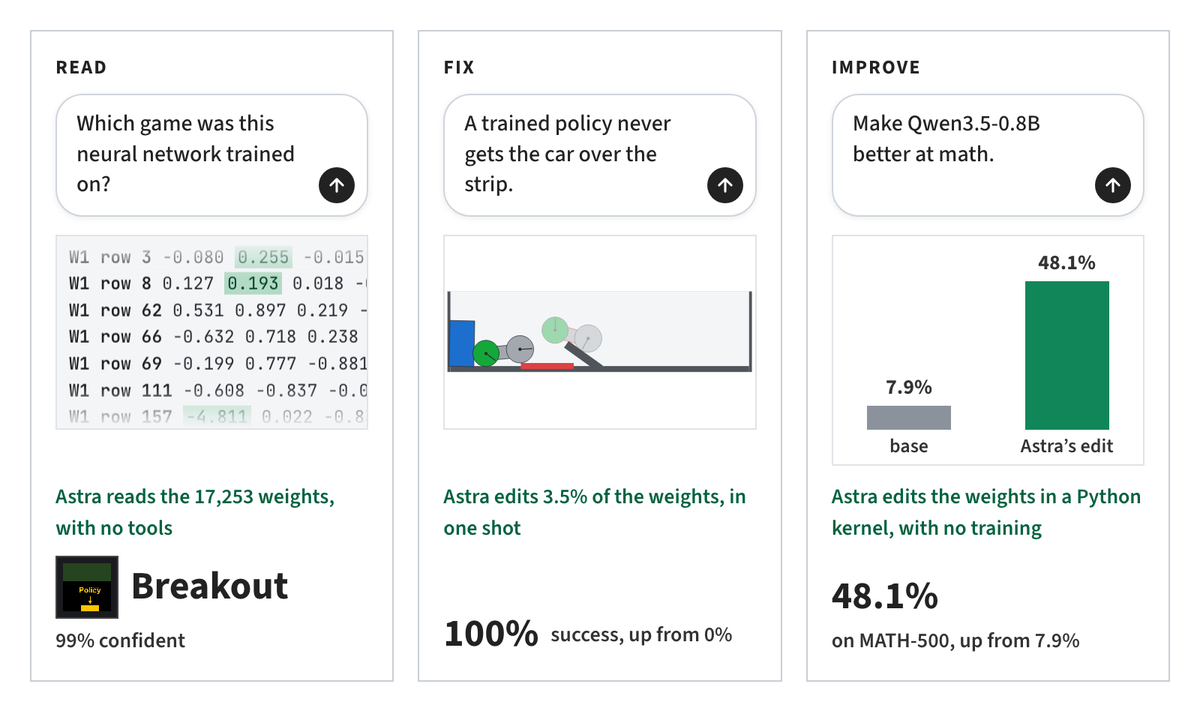
Researchers Rikiya Takehi and colleagues introduced Weight-Space Programming, a new method that allows frontier LLMs to interpret and modify neural network weights. The team demonstrated that large language models can now reason about the internal parameters of other models to perform specific tasks. This capability shifts how developers might interact with and repair artificial intelligence systems.
The GPT-6 Astra model successfully identified a bug in the Qwen3.5-0.8B model’s weights and corrected it by editing only 0.016% of the parameters. This precise intervention significantly boosted the Qwen3.5-0.8B’s performance on the MATH-500 benchmark, raising its score from 7.9% to 48.1%. The researchers also observed that the same weight edits improved the model’s instruction following performance on IFEval by three times.
The ability for a model to edit its own weights or those of another model suggests a new paradigm for model maintenance and optimization. This approach could reduce the time and resources needed to debug or improve smaller models. Developers building with AI now have a potential new tool for rapid weight correction and model improvement.

